
About / Lipo Sculpt
About Lipo Sculpt: Non-Surgical Body & Skin Treatments
An introduction to Lipo Sculpt, with space to explore your priorities, understand the information and decide which questions to ask.
Meet the subject. Make it personal.
Read at your own pace
Find a section
About Lipo Sculpt: start with the business, then your questions
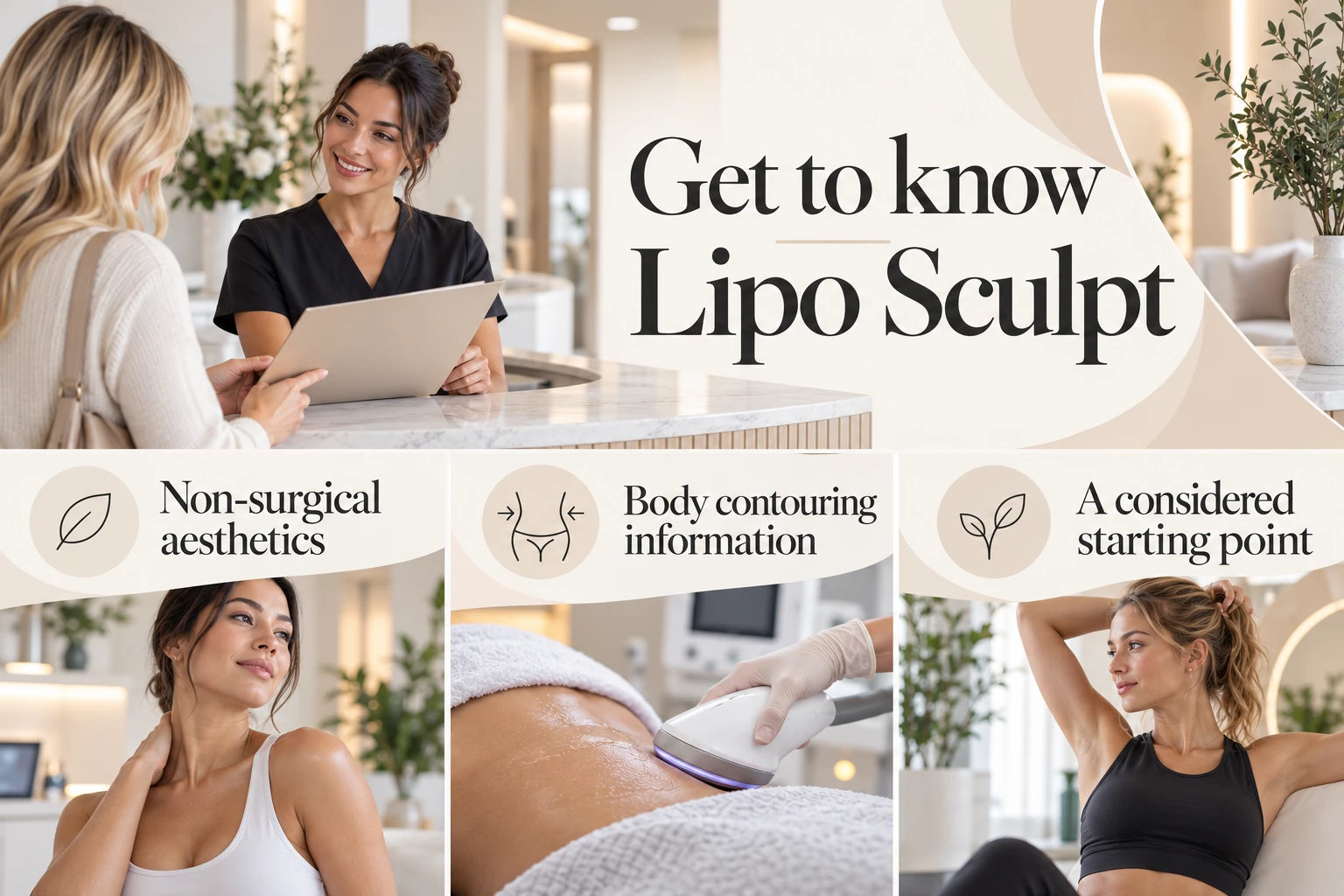
Lipo Sculpt is presented on this website as a business offering non-surgical aesthetics and body contouring. Those words describe the subject of the services; they do not tell you whether a particular option fits your circumstances. This About page gives you a way to explore the business without having to turn an initial interest into an immediate treatment decision. Begin with what you would like to understand, then use the relevant service information to make that question more specific.
An About page can help explain how to read a website, but it cannot replace information about the person who would assess you, the treatment being discussed or the terms that would apply. Keep those distinctions in view. If you need a detail about Lipo Sculpt that is not published here, ask for the current answer directly. An attractive presentation, an illustration or a broad description should never be treated as proof of an unpublished qualification, facility, result or working practice.
You may arrive with a clear topic in mind, or simply because the phrase body contouring has raised questions. Both are useful starting points. The pages in this website let you move from a broad introduction to service descriptions, consultation enquiries and practical contact information. Reading in that order is optional. The right starting place is the page that answers the question you actually have, whether that concerns the business, the booking route or the information you would need before deciding.
A category is a starting point, not a personal recommendation
Non-surgical aesthetics brings together a broad range of appearance-related topics. The category can be useful when browsing, but it does not establish that every option within it works in the same way. Body contouring is similarly a broad description. Before comparing individual services, identify what each description is referring to and whether the wording concerns a body area, an appearance concern, a device, a method or a proposed course of appointments.
When two pages use similar language, ask what distinguishes the actual procedures behind those words. Is the description about the mechanism, the intended purpose or the experience of an appointment? Which parts are general background and which parts apply to the option being discussed with you? A precise question often produces a more useful conversation than asking which service is best. The answer to best depends on the criteria being used and on information that a public page cannot assess.
Do not feel obliged to learn every technical term before making an enquiry. You can describe your question in ordinary language and ask for unfamiliar wording to be explained. If a term sounds reassuring, still ask what it means in practice. If it sounds complicated, ask which part matters to your decision. Treat service categories as signposts that help you find information, while keeping any judgement about individual suitability separate from the act of browsing them.
Describe the question before naming the treatment
It is easy to begin a search with a treatment name encountered in a post, conversation or advertisement. A different starting point is to describe the question that led you there. You might want to understand what a service involves, compare two descriptions or find out how an assessment differs from a treatment appointment. That description gives your enquiry a useful focus without assuming that the first treatment you encountered is the one to pursue.
Try writing a short statement that includes your subject, your uncertainty and the information you need next. For example, you could ask how the business explains the difference between two listed services, or what information would be needed to discuss a particular concern. Keep the statement factual. There is no need to present yourself through a catalogue of perceived flaws or adopt promotional language to make your question understandable. Your own words are sufficient for an initial enquiry.
After writing the statement, check whether it asks for information or assumes an answer. A question about what an option can and cannot address leaves room for a clear explanation. A request for a guaranteed result may conceal several separate questions about suitability, variability and expectations. Breaking those apart helps you see which points remain unresolved. You can then bring the same statement to the Services page, a booking conversation or a later discussion without starting your research again.
Read the website as several kinds of information
A website contains more than one kind of material. Navigation helps you reach a page; service copy describes a topic; contact details identify a route to the business; policy pages address information handling or terms. These elements can sit close together visually while answering very different questions. Reading them separately makes it easier to recognise what a particular sentence establishes and what it leaves for a direct enquiry.
On Lipo Sculpt, the Home page provides a broad introduction and Services is the place to explore treatment subjects. About explains the context for your research. Book Consultation concerns the next enquiry step, while Contact Us provides the approved ways to reach the business. Terms & Conditions and Privacy Policy should be consulted when your question concerns obligations, booking arrangements or personal information. A link between pages does not mean that one page substitutes for the detail on another.
As you move through the site, keep a small record of useful statements and unanswered points. Include the page name so that you can find the wording again. If a detail is important to your decision, ask whether it is current and applicable to the service you are discussing. Public copy can orient a conversation, but it may not contain every fact relevant to a specific appointment. A clear reading process gives you a better foundation for seeking those facts directly.
Separate personal priorities from outside pressure

Interest in aesthetics can begin for many reasons. A change in circumstances, a long-standing question or a conversation may prompt someone to look for information. You do not have to explain or defend that interest on a public website. It is nevertheless useful to distinguish your own priorities from the language and expectations you encounter elsewhere, especially when browsing creates the impression that an appearance decision should be made quickly.
Consider which question would still matter if you had not seen the latest image, comparison or offer. Is your priority understanding a service, learning about limitations or deciding whether to explore the subject further at all? An enquiry can remain limited to that question. You can also decide that the available information is enough for now. Gathering facts is a complete activity in its own right; it does not require you to proceed to a booking or treatment.
When discussing options, ask for time to consider information if you need it, and establish what would happen next before agreeing to that next step. A helpful written note can separate matters you understand from matters you are still weighing. This is particularly useful when other people's opinions are competing with your own. The purpose of your research is to support a decision you can explain in your own terms, including a decision to wait or stop.
Ask what an explanation actually covers
An explanation can be detailed and still leave important gaps. It may describe an intended purpose without describing the appointment, or discuss a method without explaining why it is being considered for a particular person. When you review information about Lipo Sculpt services, look for the scope of each explanation. Ask which questions the wording answers, which assumptions it relies on and where further assessment would be required.
Useful follow-up questions can concern what happens during an appointment, what information is reviewed beforehand and what would make an option unsuitable. Ask which risks, limitations and alternatives would be discussed for the proposed service. If an answer uses a broad expression such as a personalised approach, ask what that would mean in the specific conversation. The aim is not to demand an extensive explanation of everything on the website, but to obtain clear information about the option under consideration.
Also ask how you can revisit the information after the conversation. Would relevant details be available in writing, and which documents should you read before making a decision? Do not assume that a general page covers the same ground as individual advice or consent information. Those are different stages with different purposes. Recognising the boundary between them helps you identify the explanation you need next and prevents a general introduction from carrying more weight than it can support.
Treat unknown details as questions, not assumptions
This website does not publish every possible detail about the business. Where a fact is absent, leave it open until it is confirmed. That applies to who would be involved in an appointment, where it would take place, what arrangements would apply and which qualifications relate to the proposed service. An absence of information is a reason to ask a focused question; it is not evidence for a favourable or unfavourable conclusion.
You can prepare a short verification list organised around the actual decision. Ask who would assess you and who would provide the service, whether those roles are the same, and what relevant information can be supplied about them. Ask which location and practical arrangements apply to your enquiry. If a particular credential, regulatory status or insurance detail matters to you, request a precise current answer rather than interpreting design features or general professional language as a substitute.
Keep your list proportionate. You do not need to investigate every aspect of a business before asking a basic question about how to make contact. As the possibility of an appointment becomes more concrete, the details that matter become clearer too. This staged approach lets you build understanding without pretending that a public About page verifies facts it does not contain. It also makes any later conversation more productive because the unresolved points are already visible.
Look at images with the right expectations

Images can make a topic easier to follow by illustrating an enquiry, an information discussion or the process of organising questions. They also shape the atmosphere of a page. Neither function makes an image evidence about the business. Unless an image is explicitly identified and supported as a factual record, do not infer that a pictured person works at Lipo Sculpt, that a setting is an actual premises or that a scene documents an appointment.
The same distinction matters when looking at any image associated with aesthetic services. A photograph or infographic can provide context while remaining separate from information about an individual outcome. Lighting, pose, composition and editing influence what a viewer sees. Ask for the explanation behind any image that is being used to support a result claim, including what comparison it represents and whether it is relevant to the service you are considering. A visually persuasive example does not establish what would happen for you.
Use the words around an image to identify its purpose, then return to the practical questions. Does it help explain a term, organise a process or simply introduce a topic? That answer tells you how to use it. The content on this About page is intended as an editorial guide to researching Lipo Sculpt. Illustrations should be read within that purpose, with business details and treatment information checked through the appropriate written material and direct discussion.
Make comparisons on matching terms
Comparing websites is easier when you compare the same kind of information. A general description from one business cannot be fairly matched against a detailed individual proposal from another. Similarly, a headline about a service does not tell you whether its appointment structure, assessment requirements or included support match another option with a similar name. Establish what is being compared before deciding that two descriptions are equivalent.
A practical comparison note can use a few consistent questions: what exactly is proposed, who would provide it, what information is needed beforehand, what limitations are explained and what arrangements apply afterwards? Leave blank spaces where an answer has not been confirmed. A blank is useful because it identifies your next enquiry. Filling it with a guess can make a comparison look complete while hiding the most significant uncertainty.
Cost information also needs matching context if you request it. Ask what a quoted amount includes, whether the proposal concerns one appointment or a wider plan, and which additional charges could arise. This About page does not publish treatment prices or imply that a particular payment arrangement is available. The comparison method is simply a way to organise answers you obtain. Use it to understand differences, rather than ranking options by a single attractive phrase or a headline that leaves the underlying proposal unclear.
Understand the difference between enquiry and commitment
An initial enquiry, a consultation request and an agreed appointment can be separate stages. Before moving from one to another, ask what the proposed step means. Does a request simply ask the business to discuss availability? Would an appointment be confirmed only after further information? Is there a charge associated with the next step? Clear distinctions are especially useful when a website uses a short action label that cannot explain every practical detail.
The Book Consultation page is the relevant starting point for exploring that route on this website. Read it together with the current Terms & Conditions, then ask about anything that remains unclear. Establish how a proposed booking would be confirmed and which information would identify the agreed arrangements. Do not infer that selecting a link, making a general enquiry or expressing interest necessarily establishes a treatment plan or an entitlement to a particular service.
If your circumstances change while you are considering an appointment, seek the current arrangements before acting on assumptions. Questions about changes, cancellation or payments belong with the terms for the actual booking. Keep any confirmation and relevant correspondence accessible so that you can refer to what was agreed. Understanding the stage you have reached helps you communicate clearly with the business and keeps an information-gathering conversation from being confused with a later commitment.
Plan your practical questions before arranging time
Practical information can be as important as a service explanation when deciding whether to explore an appointment. Think about the details you would need to organise your time, travel or other responsibilities. Ask for the location and appointment arrangements that apply to your enquiry, since this About page does not publish a physical address or business hours. Confirm those details directly before making plans that depend on them.
You may also want to ask about appointment length, arrival instructions, accessibility or whether someone can accompany you. Phrase these as requests for current information rather than expectations about what the business provides. If an access need would affect your ability to attend or communicate, raise the practical requirement and ask which arrangements are possible. The answer should come from the business for the relevant appointment, not from a generic description or an illustrative image on the site.
Write down the confirmed details alongside your original questions so that the practical and informational parts of your enquiry remain connected. A date alone may not tell you everything you need to know. Before setting aside time, establish the purpose of the appointment, the expected format and any preparation information supplied by the business. This helps you recognise when you have enough information to plan the next step and when a short follow-up enquiry is still needed.
Keep personal information proportionate to the stage

An early enquiry may concern a general service description or a practical booking question. Consider what personal information is necessary to ask that question. You do not need to include a detailed personal account merely to request an explanation of a term. If the conversation moves towards assessment, ask how any information requested relates to that purpose and how it should be provided through the appropriate route.
Read the Privacy Policy when your question concerns collection, use, retention or disclosure of information. If a policy statement is unclear, identify the specific point and ask for clarification. Social pages and a direct business conversation can have different practical contexts, so do not assume that every channel is suitable for discussing sensitive details. A public comment can be visible to other people; keep that in mind when deciding how to make a general enquiry.
You can ask the business which route it recommends for a particular kind of information before sharing it. That question does not require you to reveal the information itself. Keep copies of the privacy information relevant to a decision if you need to refer back to it. This page does not set out a separate privacy policy or promise a particular handling process. It helps you identify when to consult the published policy and when to request a more specific explanation.
Prepare a conversation you can actually use
A long list of questions can become difficult to manage in a conversation. Choose the few points that would most change your understanding, and put them first. One may concern the service itself, another may concern who would assess you, and a third may concern practical arrangements. You can retain the longer list for reference while keeping the opening enquiry focused enough to answer clearly.
For each priority, write what would count as a useful answer. If you ask how a consultation works, you might need to understand its purpose, format and relationship to any later appointment. If you ask about a service, you might need an explanation of its limits and the circumstances in which it would not be appropriate. Thinking about the information you need helps avoid accepting a broad reassuring phrase when a concrete detail remains unanswered.
Leave space to record unfamiliar terms, follow-up questions and points you want to check later. You can ask for an explanation to be repeated or put into plain language. If several options are discussed, identify which answer belongs to which option. After the conversation, read your notes once without making a decision immediately. Look for missing information, inconsistencies or questions that only became apparent while listening. A prepared conversation is useful because it produces a record you can assess, not because it commits you to a next step.
Know where different questions belong
Directing a question to the right subject helps you find the answer sooner. A query about what is listed belongs with Services. A query about making a consultation enquiry belongs with Book Consultation. A query about reaching the business belongs with Contact Us. Questions about booking conditions or personal information should begin with Terms & Conditions or Privacy Policy respectively. About offers a wider framework, but it should not become a replacement for those pages.
Lipo Sculpt's approved telephone contact is 03300101799. Its listed social destinations are Facebook at the approved Lipo Sculpt page and LinkedIn at the approved company page. These routes identify ways to reach or view the business; they do not establish response times, availability or arrangements for any particular appointment. If you need to know which channel suits your enquiry, ask that practical question directly and follow the current guidance provided.
Be specific about what you are requesting. A message asking for clarification of a published sentence is different from a request to arrange an appointment. Referring to the page and topic can help avoid confusion, especially if you have browsed several services. Keep the initial question concise, then provide additional context when it is requested through an appropriate route. This keeps the enquiry centred on the information needed next without implying that every detail should be supplied at the first contact.
Review the answer before choosing the next step
Once you receive information, consider it against the question you began with. Did the answer explain the subject you asked about, or did it introduce another option that needs its own explanation? Have the practical details been confirmed? Are the limitations understandable in your own words? Reviewing the answer in this way helps you distinguish new information from a change in the direction of the conversation.
You can organise your notes into confirmed details, matters to clarify and decisions you are considering. This is a working record for you, not a requirement to present a formal document to the business. If a detail seems inconsistent with the website, quote the relevant wording and ask which information is current. If you need to discuss a health-related matter, seek an appropriate individual assessment rather than trying to resolve it solely by comparing public descriptions.
The next step might be a further question, reading a policy, arranging a discussion or taking more time. Any of those can follow logically from research. Avoid treating progress as a sequence that must always end in treatment. A useful decision is one based on information you understand and circumstances you have considered. When an answer does not yet provide that foundation, identifying the missing point is meaningful progress in itself and gives your next enquiry a clear purpose.
Return to your own reason for researching
After exploring the pages, return to the short question that started your visit. You may now have a clearer understanding of the vocabulary, the business contact route or the details you would need for an appointment. You may also have discovered that your original question was too broad. Refining it is a useful outcome: it allows you to ask for relevant information without being drawn into every subject presented on the website.
This About page deliberately focuses on how to investigate Lipo Sculpt rather than presenting an invented history, team biography or collection of results. Details that are not established here should be sought directly where they matter to you. The business category, the approved contact routes and the page directory provide orientation; individual services and booking questions require their own information. Keep that distinction when you return to the site or discuss what you have read with someone else.
You can finish your visit with one practical action: save a question, read the related service page, check a policy or make a focused enquiry. You can equally close the page and return later. The aim is to make the research easier to organise and the next conversation easier to follow. Choose the step that addresses your remaining uncertainty, and continue only as far as you have the information and interest to do so.
Your next step